MENU

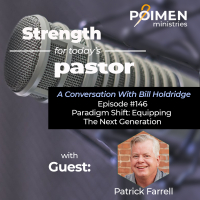
Pastor Patrick Farrell shares his testimony regarding a radical and defining moment in his church leadership that allowed the Holy Spirit to rejuvenate, reorganize and resurrect new life into his church. BELOW ARE THE SHOW NOTES AND ARTICLES DISCUSSED: Calvary Chapel Wichita, Kansas Paradigm Shift: Equipping the Next Gen By Patrick Farrell, Senior Pastor Article A Several years ago, I was talking to a pastor friend about prophecy. That’s not unusual for me. I came to Christ through the study of prophecy, and to this day I love to talk prophecy and I love to teach prophecy. So much so that for years I eagerly assembled an annual “prophecy update” and every two or three years turned it into a whole conference. That particular conversation, however, changed my entire perspective not only on biblical prophecy, but on ministry. “Has it ever occurred to you,” my friend asked, “That every generation of the church was convinced it could be the last? And they believed that for good reasons? Have you ever considered that for 2000 years believers have scrutinized the “signs of the times” and concluded the return of Christ was imminent?” I can’t recall exactly what I said in response, but I remember that it was flip. Knowing me, I probably said something to the effect of: “Duh. That’s why they call it the doctrine of imminence.” We went on to talk about other things, but days later I found myself still pondering the implications of my friend’s observation. For centuries (!) believers who had not seen the return of Israel, who could not realistically envision a global government, and who could not fathom “mark of the Beast” technology, still prayed “Maranatha” in full expectation that God might answer that day. And for centuries, Jesus has tarried. “What if…” a voice whispered in my head. “What if Jesus continues to tarry?” At first, the idea seemed laughable. How could He? I reminded myself of all the indications that the book of Revelation must be right around the corner. Geopolitical, financial, technological, cultural, spiritual — it all lined up. Surely Christians of our generation would be the ones that finally saw the return of Christ. But over the next few days the thought that began as a whisper grew louder and louder in my mind: “What if we’re not?” Unable to escape the question, I was soon unable to avoid the answer: I was doing ministry wrong. I was doing all the right things — or at least most of them. I was teaching the Word, sharing the gospel, making disciples, loving the people. And I was “equipping the saints for the work of the ministry.” My friend’s question, though, brought me to the disappointing realization that along the way I’d amended Paul’s words to the Ephesians. Yes, I was equipping the saints for the work of the ministry. But I was equipping them just in case Jesus didn’t return in the next few years. My teaching of prophecy had passion and urgency. Jesus was coming SOON. Getting that message out, in my mind, was of utmost priority. Training young people for ministry was a secondary consideration. I was approaching it casually. While I never explicitly thought of it that way, it was essentially a back-up plan. And it needed to not be. We don’t know when Jesus is coming back. We have good reason to believe it might be any day — or even today! But so has every believer since Pentecost, and yet the church is still here. We need to not let our excitement over prophecy blind us to the very real possibility that the church will still be in ten years. Or twenty. Or forty. Or longer. And if the church does remain, it deserves to be prepared for the ministry that’s waiting. More than that, it deserves to be prepared passionately, rigorously, and lovingly — not half-heartedly. It deserves to be prepared as intentionally as my generation was. The way that every generation was. Even as they awaited the soon return of Christ. Article B A pastor friend refers to Calvary Wichita as “a ministry training program disguised as a church.” I find that description somewhat redundant. Aren’t all fellowships supposed to equipping the saints for the work of the ministry (Eph 4:12)? And yet for many years, ours wasn’t. Week over week the same faithful faces would serve in the same familiar places. The ushers, the nursery workers, the worship team — they were all loving, all gifted, all beyond reliable. Except that towering strength had become a significant weakness: because our servants were so dependable, and had been so reliable for so long, leaders saw little incentive to train anyone else. Eight years ago, however, several events conspired to catalyze a transition. The most significant was the “retirement” of several long-serving brothers and sisters. Some were contending with health issues, others felt led to spend more time with grandchildren and great-grandchildren, others were moving out of state. The common denominator, though, was after literally decades of faithful ministry, (including two difficult pastoral transitions) we had a generation of servants ready to pass the baton. In speaking with those stepping down, however, I discovered something both surprising and disturbing: every single one indicated they would have preferred to step down sooner. They’d been hanging on, for the most part, because “there wasn’t anyone else to do the job.” CS Lewis said that when a whisper doesn’t work, God uses a megaphone. God was shouting at us that something needed to change. A few weeks later we held an “all hands” servants meeting with a very simple four-point agenda. Point #1 – effectively immediately, everyone was “fired.” No one was a pastor, no one was an elder, no one was an overseer, no one was a servant. We were all brothers and sisters in Christ, nothing more. Point #2 – effectively immediately, all ministry roles were to be considered open and available. No matter who had been serving where or how well or for how long, everything was up for grabs. The 30-year veteran of the nursery was welcome to pray about serving on the worship team; the brand-new church member was welcome to pray about serving in the nursery. Or the worship team. Or wherever. Point #3 – I’d be scheduling meetings with everyone over the next three weeks to talk and pray with people about where they felt the Lord was calling them. Point #4 — people were exhorted to seek the Lord’s direction for their ministry without concern for where they were needed or what ministries would be left uncovered. The results were amazing. To be sure, the first response for many was shock. Even the elders who helped plan the meeting admitted later they didn’t expect we’d actually go through with it. Once people understood the heart behind the message, however, they took it seriously and took it to the Lord in prayer. A month later, we had two board members step down, an elder relinquish his ministry, three overseers hand over responsibility, and at least a dozen people change ministries. Some were reluctant, and yet convinced that God was leading them to a transition. Some were excited that God had answered their prayers to open new doors. Many were relieved to know that they “had permission” to pray about a new direction. Not surprisingly, after we’d rearranged roles and responsibilities according to God’s leading, some significant holes remained. Looking back, it was at that point our internship program was born. We’d had interns in the past, but observing the gaps in our org chart and recognizing the reason for them, it was clear a more substantial initiative was required. We needed to do more the “fill the gaps” — we needed a sustainable plan. After much prayer, we devoted a Sunday morning service to clarifying a new vision for our fellowship. Our mission would remain to “win, build, and send” disciples for Jesus Christ. But in pursuit of that mission, Calvary Wichita would begin to prioritize discipleship of the “next generation” of ministry-minded men and women. We would, in effect, become a “teaching hospital.” While every church is (or should be) a “hospital for sinners,” those coming to our hospital would be told to expect students and interns to be the front line of care. The pastors and elders would be the “attending physicians” supervising their ministry – all under the headship of the Great Physician. The transitions weren’t always seamless. While many of our “senior saints” were excited about the transition, some were confused and one or two were resentful. For a time, the extraordinary time and attention devoted to one demographic left others feeling neglected (and objectively they probably were). Predictably, we also needed to contend with pride and accusations of pride. Satan is a liar and a thief, and for a time it seemed we were a prime target for his antics as confusion and frustration seemed to spring up out of nowhere. Yet through it all, the Lord was faithful: faithful to guide, faithful to provide wisdom, faithful to supply grace, faithful to reassure us we were on the right track. Today, the day-to-day leadership of our fellowship is largely in the hands of our interns. We currently have eight, but the number varies. True to our mission, we have sent out many men and women to assume leadership roles in other churches and parachurch organizations. As we do, the Lord raises up others to take their place. We don’t have a consistent structure for our internships — we’re a small enough fellowship we have the luxury of praying through an individualized path for each of them to learn, lead, make mistakes, and grow in grace. We also have a stable enough cadre of elders that I can devote a substantial portion of my week to mentoring this crazy band of leaders-in-training, knowing other mature eyes are helping oversee the big picture. Year over year the character of the group changes, and their responsibilities change accordingly. Year over year, our fellowship extends grace, knowing this is ministry the Lord has called ALL of us to. Like a lot of ministries, sometimes we’re not sure how it’s going to all work out. Like a lot of ministries, sometimes we’re absolutely sure it won’t. Like everything the Lord calls us to, it always does! Article C Calling what we do at CCW an “intern program” might be an overstatement. We don’t have a formal program so much as we have a collection of interns — usually seven or so at any given time — that the Lord has called our fellowship to support and equip for ministry. And we didn’t begin with any particular design or structure in mind. We just observed we had a generation of leaders ready to start handing over responsibility, and prayed about how to respond. After nine years, though, we can look back and see how the Lord has worked. Roughly half the thirty-plus men and women who have spent time interning with us are currently serving in leadership roles in their respective churches, including one senior pastor, three assistant pastors, five youth pastors, two church planters, two worship leaders, a high school teacher, and a staff member at a parachurch organization. Many others are living out God’s call as parents and as missionaries in their respective vocations. How do we do what we do? The most honest answer might be: “Never the same way twice.” God seems to constantly be reinventing what we do based on the season our fellowship is in and who our interns are at any given time. That said, I can try to point at a few consistent principles the Lord has led us to: START WITH YOUTH: Our internship program for ministry-minded “twenty-somethings” evolved out of our summer youth discipleship program built around ten weeks of full-time study and service at the church. It brings teens deeper into the greater church community, helps them catch a vision for ministry, and instills in many a true heart to serve. Roughly half our interns are “home grown” graduates from our youth program; another quarter are friends or Bible College classmates who hear about what we’re doing through them. EXPLAIN THE VISION: Seven years ago, we embraced a new ministry concept: we’re a teaching hospital. Every church is a “hospital for sinners” but we’re a hospital that’s also training practitioners. Much like a medical school that sends its students into ERs and ORs and ICUs to provide care under the supervision of attending physicians, we let our folks know up front that the first line of ministry at CCW will often be led by our interns under the oversight of a pastor or elder. COUNT THE COST: Equipping the next generation is an investment. We remind our fellowship of that often, because we’re collectively sharing that cost in many ways. We’re not only supporting interns through our tithes and offerings, we’re also forgoing other opportunities in order to do so. Several years ago, for example, we hit pause on a plan to expand our sanctuary and used the money to buy a small bungalow to house interns instead. We unpack these choices for the fellowship so they understand our interns are a community project that every one of us is a part of. REJOICE IN IMPERFECTION: Putting interns out on the front lines of ministry entails not only an investment of money but an investment of grace. Most of the time they will not teach as effectively, lead worship as powerfully, counsel as wisely, or organize as skillfully as more seasoned elders would. We don’t try to pretend that’s not true; instead, we try to rally around it and urge one another to “celebrate progress” rather than “expect perfection.” RECOGNIZE THE CHALLENGE: One of the most difficult things any of us do is watch someone perform a task slowly and awkwardly that we could do quickly and easily. But that’s exactly what mentoring interns requires. If we don’t let them do the thing we could do in a fraction of the time, they don’t learn. And if we don’t watch them, they might do things badly (and people might get hurt). EMBRACE DIFFERENCES: I come from a large church where I helped start and run a successful “School of Ministry.” We had classes, we had structure, we had a format for everything. CCW is less than 10% the size of my home church, and our internships have less than 10% of the consistency. We have paid interns and unpaid interns. We have full-time interns and part-time interns. Some interns are with us for a summer; some have been with us for years. Some of their discipleship happens in groups, but differences in schedule, gifting, calling, and maturity demand that a fair amount happen 1:1. Some of our interns love to read; others learn much better from audio or video presentations. For a long time we tried to resist these realities in the name of efficiency. Today we accept the inefficiency for the sake of higher quality. PURSUE BOTH BREADTH AND DEPTH: It’s tempting, especially in a small church like ours, to thrust people into the ministry that corresponds to their most conspicuous gifting: put the musician on the worship team, put the organizer in the office, put the “baby whisperer” in the nursery. It’s also tempting to do the opposite: don’t let people serve in their favorite ministry for the sake of learning and growth and (above all) humility! Our answer is a little of both: we strive to give interns the opportunity to refine existing gifting while also expecting them to explore new areas of ministry where they have interest and the church has need. What we don’t do is assign anything purely for the sake of cultivating humility. God, it turns out, is better at that than we are. BE INTENTIONAL ABOUT COMMUNITY: Fellowship within our group of interns usually happens organically. And that’s important — what our interns learn from each other is often as important or more important than what they learn from their pastors and mentors. But just as important is what our interns can learn from people who are neither peers nor mentors. We try to create opportunities for interns to know and serve and pray and live life alongside live life alongside young parents, seniors, singles, new believers, and everyone else that calls Calvary home. BUILD IN THE BASICS: If we’re not careful, in striving to create opportunities for community and ministry we might inadvertently encourage our interns to neglect devotional time and other essential spiritual disciplines. Instead, we lean hard in the opposite direction. We build time for daily prayer and worship into our full-time interns’ schedules, and we ask all interns to pursue accountability around their individual walks with the Lord. As much as we want to train up ministers, it’s more important we teach people to be zealous Christ-followers. PREPARE FOR HEARTBREAK: When we embarked on this intern journey, everyone was excited at the prospect of being a “Paul” to a “Timothy” or “Titus.” What we forgot was that Paul also had disciples like Demas (who abandoned him) and Alexander (who attacked him). Even Jesus — who did ministry perfectly — had both a Peter and a Judas. Mentoring interns has brought me to some of the highest mountains I’ve known as a pastor, but it’s also plunged me to some of the deepest valleys. Getting close enough to wash feet means getting close enough to be kicked, and it’s never going to be different until we get to heaven. DEBRIEF EVERYTHING: Most ministry is “caught” rather than “taught.” That said, we find our interns catch a whole lot more if we set aside structured time to discuss the ministry they are a part of as well as the ministry going on around them. We try to meet as a group after every event, at the end of each week of ministry, and at the close of each Sunday to discuss what happened, why it happened, what follow-up might be needed, how we can be praying, etc. More than anything else we do, these conversations help our interns understand the heart of our ministry. Looking back, the first ten bullet points above are really the product of the last one. It was in talking about and praying over our ministry that the Lord led us to make internships such a vital part of our fellowship’s DNA. And it’s been through discussion and prayer that the Lord has cultivated and refined the “best practices” outlined above. The two questions we ask continually — of each other and of the Lord — are simple: (1) What does love look like in this situation? (2) Who else needs to know what we’re discussing? When someone asks me how to start an internship program, I still don’t know. But what I tell people is to find the young people in your church who want to serve, find a place for them to serve, and start talking about those two questions with them every chance you get. You’ll be amazed at what the Lord will do!
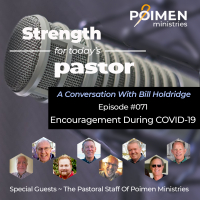
This episode features eight of our staff pastors... we gathered together for one of our not-as-regular-as-we-should pastor chats, and we decided to record our collective thoughts on COVID-19 and its effect (amazing) on the kingdom of God. Listen to testimonies and anecdotal evidence of God being on the move! Be encouraged! Let the Holy Spirit broaden your vision, and enlarge your borders! And, feel free to pass it on... This will be encouraging for pastors. Most certainly, the Lord has not lost His position as King of the universe and Lord of heaven and earth. And of the church. Join show host Bill Holdridge for this interesting discussion.
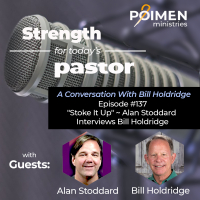
Alan Stoddard is the author of the Stoke It Up Podcast, and is a former Calvary Chapel Senior/Lead pastor. He is currently prepping for a new church plant in Granbury, Texas. Alan recently discovered that Bill Holdridge had been a church planter himself back in the day ... so he decided to interview him. The discussion takes a number of twists and turns ... it's about church planting, pastoral calling, the days of the Jesus Revolution, and other topics in the fast-moving interview that testifies to the faithfulness of God. Hope you enjoy it. ____________________________ Dr. Alan Stoddard is the co-author of the book Groups that Revitalize, which deals with the subject of sermon based small groups. Sermon based small groups a powerful ministry opportunity that multiplies the reach of the pulpit. Dr. Alan Stoddard shares some of the ministry philosophy behind sermon based small groups as well as the Biblical precedent and tips and tricks to make the best curriculum questions possible. You can read Alan's Doctoral thesis here: https://www.yumpu.com/en/document/view/16328189/teaching-pastors-to-reinforce-expository-preaching-alan-stoddard Or read his book here: https://www.amazon.com/Groups-that-Revitalize-Bringing-Sermon-Based/dp/1733690387 Alan serves as the Lead Pastor of Calvary Ruidoso, in Ruidoso, New Mexico. He has pastored churches in Texas and New Mexico. He has a real passion for making disciples in small groups. He's married to Jeana and has a daughter, Briana. Recommended Episodes from The Expositors Collective: How to Lead an Interactive Bible Study: https://www.expositorscollective.com/podcast/2019/3/12/episode-38-how-to-lead-an-interactive-bible-study Learning from John the Baptist: https://www.expositorscollective.com/podcast/2021/2/16/learning-from-john-the-baptist-george-scanlan The Power of Connection: https://www.expositorscollective.com/podcast/2020/9/1/the-power-of-connection-eric-cartier
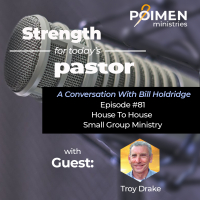
Do you want to discover or maybe even reignite the small groups ministry of your church? Troy Drake is the founding pastor of Calvary Chapel Meridian, Idaho, having served as its pastor since 2009, and has led their church into this important area of discipleship ministry. Here's a quote from the church website: "Now all who believed were together, and had all things in common, so continuing daily with one accord in the temple, and breaking bread from house to house, they ate their food with gladness and simplicity of heart, praising God and having favor with all the people. And the Lord added to the church daily those who were being saved." (Acts 2:46-47) "The early disciples understood that togetherness is essential for the growth of each person and the church itself by being in close community with other believers. The Christian life is way better in community! And yet, this is the one area that is often lacking in the lives of Christians. "We must intentionally 'do life' together. Rather than just hoping that it will happen, we have chosen to set up a purposeful way for the people in our fellowship to engage with each other. We call them House2House Groups. "What can you expect at an H2H Group? Each group has a meal together, they discuss & apply Sunday’s sermon, and support each other in prayer and practical ways as they seek to join in God’s mission." So tune in, and get some fresh ideas that may trigger fresh vision that will help your fellowship do the one anothers of the New Testament.
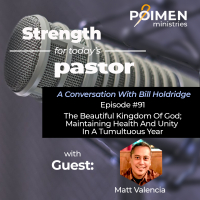
Matt Valencia has a huge heart for God’s Kingdom, and a sincere love for the greater Body of Christ. Recently, Matt was asked to lead a discussion on the topic of this podcast. This interview dives into the meat of that discussion, and why it matters. Matt Valencia is the Lead Pastor of the Regeneration Church of Scotts Valley, CA and is also the founding pastor of Calvary Chapel in Gilroy, CA.

This conversation between host Bill Holdridge and Ron Arbaugh is all about the venture of faith he’s been on for the last 25+ years of ministry in the Lone Star State. God loves faith, it pleases Him. He loves it because it honors Him … when a man trusts God to do what He wants to do and is able to do, it pleases Him. He loves to work on behalf of His believing children. Pastor Ron is the founding pastor of CC San Antonio, the 2nd largest city in Texas. The Lord has used Ron and his fellowship in many marvelous ways. Dramatic testimony. Overcoming an impairment. Trusting the Lord for the huge things He wanted to do. Living scared, but trusting in the provision and guidance of God. Consistent, faithful development of pastoral level leaders. The list goes on. It's the grace of God, and Ron is the first to tell you that. Super encouraging stuff!
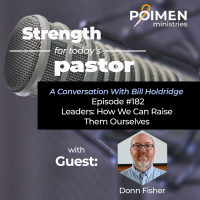
Many churches are experiencing a leadership deficit. There are too few biblical elders, too few deacons, and not as many people who know which spiritual gifts they’ve been given by the Spirit, what they are called to do, or what ministries the Lord has opened up for them. Many leadership teams are not in alignment with their pastor in doctrine and practice, nor are they in alignment with each other. There are many fellowships — normal sized (50-200 regular attenders) — that believe they do not possess the resources to begin strong leadership development and equipping and training of the saints. That's what this podcast is all about. It's going to help the equipping senior pastor do the work of equipping those whom the Lord is calling into leadership ministry positions. And, he doesn't have to have it all figured out. He can join others who are part of what pastor Donn Fisher of Calvary Chapel Raynham, Massachusetts is talking about in this episode. There is an include transcript of this podcast interview, which may be helpful to you with your notetaking. Matthew 28:18-20
A clear and timely message from long time assisting pastor James Chapman of Calvary Chapel Stone Mountian, GA on what is needed in a servant who serves the senior pastor.